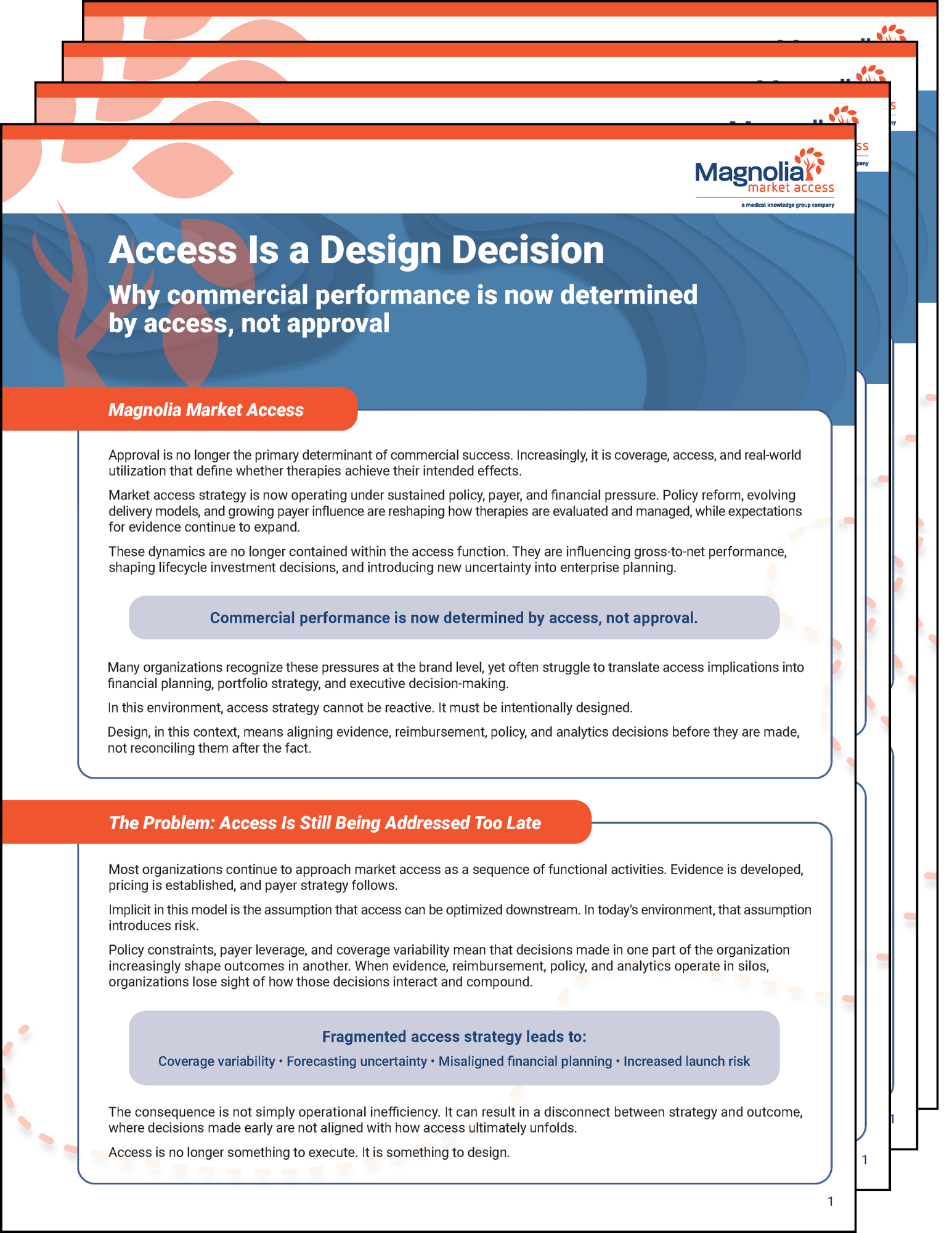
Access Is a Design Decision: Why Commercial Performance Is Now Determined by Access, Not Approval
Approval is only the starting point. Access is shaped by coverage decisions, utilization management, and evolving policy dynamics.
Access decisions now determine whether therapies are adopted, restricted, or fail to reach patients at scale.
Coverage variability, utilization management, and policy pressure are increasingly shaping real-world outcomes. Most organizations still approach market access as a downstream function. In today’s environment, that approach introduces risk.
Access decisions now influence revenue predictability, gross-to-net performance, and portfolio investment decisions, yet these implications are not always fully integrated into planning.
When access strategy is treated as a downstream function:
Evidence may not align to payer decision criteria
Pricing and reimbursement assumptions may not hold
Forecasts may not reflect real-world access conditions
The result is not just inefficiency. It is misalignment between strategy and outcome.
Access strategy needs to be designed before coverage, pricing, and commercialization decisions are already in motion.
This piece examines how biopharma teams can bring reimbursement, evidence, policy, and analytics together earlier to anticipate risk, align decisions, and improve access readiness.
What this requires in practice: