Patient Support Services Modeling, Made Actionable
A data-driven approach to patient support services modeling that helps manufacturers forecast demand, evaluate program design, and manage affordability, access, and cost with confidence.


A data-driven approach to patient support services modeling that helps manufacturers forecast demand, evaluate program design, and manage affordability, access, and cost with confidence.
Prescription drugs represent only a small portion of the overall difference in health care spending between the United States and comparable OECD countries. In 2021, prescription drug spending accounted for approximately $550, or 9.7%, of the $5,683 per capita spending gap, while inpatient and outpatient services accounted for nearly 80% of the difference. Administrative costs represented about 12% of the gap, highlighting the significant role of system complexity and operational overhead in driving higher U.S. health care spending.
Market access is increasingly shaping biopharma decisions earlier in the lifecycle. This article explores how policy uncertainty, evidence expectations, and access strategy are influencing development, investment, and long-term value realization.
How a biotech company equipped HCPs to navigate acquisition, coding, and coverage for a dual-therapy regimen.
How a manufacturer integrated imaging requirements into its access and patient support strategy.
As policy dynamics accelerate across federal and state channels, manufacturers must prepare for multiple scenarios and align internal planning. Key readiness priorities for 2026.

See how a smarter coding strategy helped a medical device company strengthen payer alignment and accelerate access.
Design research payers can use: focus on real-world outcomes, durability, and total cost of care; bring payer input in early and often; and pressure-test access levers pre-launch. Turn strong science into coverage, reimbursement, and measurable ROI.

See how Magnolia Market Access helped a manufacturer overcome coding gaps, payer unfamiliarity, and site readiness challenges to launch the first FDA-approved therapy in a rare disease — creating a replicable, gold-standard access model.
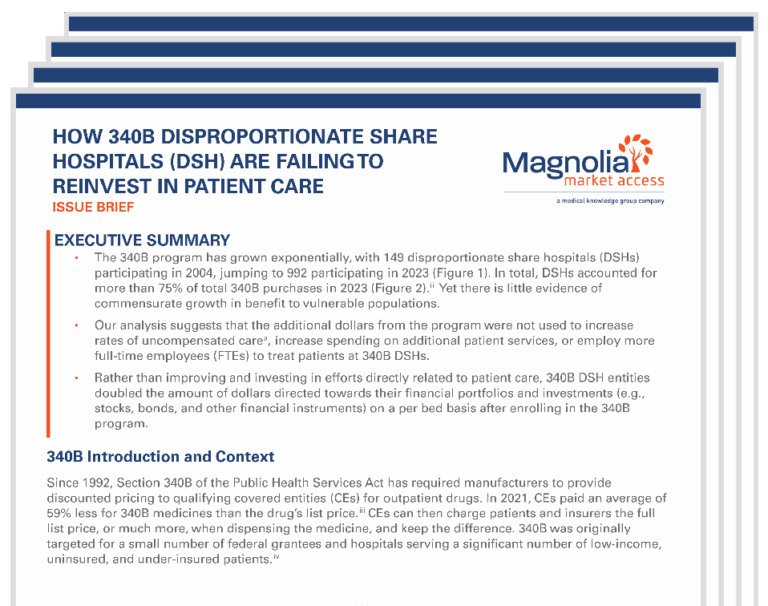
This issue brief provides insights into how 340B savings are being redirected by covered entities—particularly DSH hospitals—toward financial investments instead of patient care, underscoring the urgency of policy changes to realign the program with its mission.